Dogs
Train DreamsDogs are among the most persistent nonhuman presences in Robert Grainier’s life, occupying the unstable ground between household companionship and the surrounding wilderness. They feed him, follow him, disappear from him, return bearing the signs of the wolf world, and become the subjects of increasingly improbable local stories. Through them, the narrative measures both the changing ecology of the Moyea Valley and the human need to interpret animal behavior as loyalty, intelligence, threat, or kinship.
Companionship After the Fire
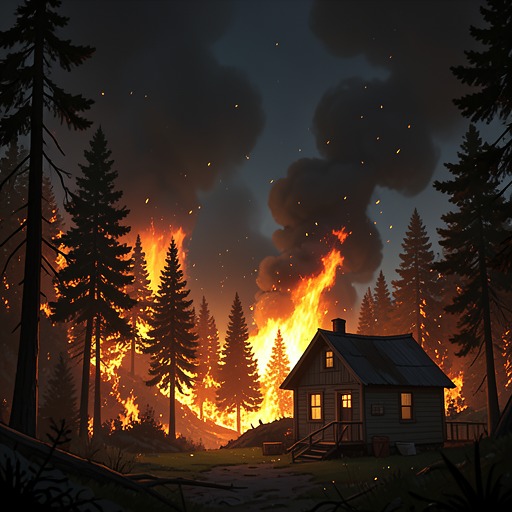
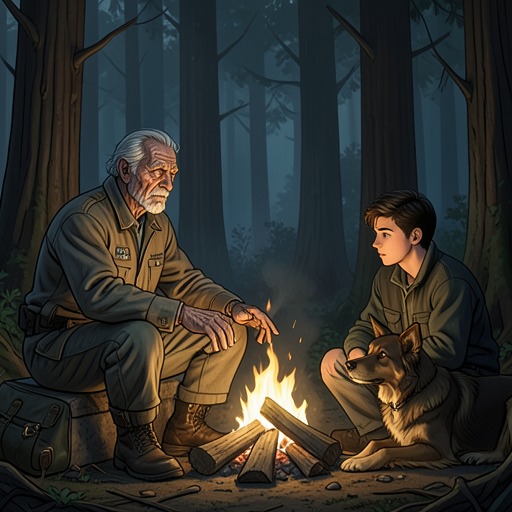
After the 1920 Moyea Valley fire destroyed Grainier’s homesite and killed Gladys Grainier and the baby Kate, a small red-haired female dog came to his camp. She stayed with him while he lived beside the blackened riverbank, and her presence altered the texture of his solitude. Grainier had been talking aloud to himself amid visions of Gladys’s bonnet and the chocolates he imagined scattered across the burn; once the dog was there, he became ashamed of being overheard and stopped speaking to himself. The dog therefore served not merely as protection or practical help but as a witness before whom he tried to preserve a human manner of conduct.
The animal’s life was partly independent of him. She lived on goat’s milk, fish heads, and whatever she could catch, and she sometimes wandered away for days. Grainier accepted this intermittent companionship rather than trying to make her fully obedient. When autumn approached and he prepared to leave the burned settlement for Bonners Ferry, he explained that keeping a dog in town was not his nature but that an elderly dog might not survive winter alone in the hills. He offered to pay an extra nickel to take her by train as far as Bonners Ferry. The dog vanished on the very day he gathered his possessions, and Grainier departed without her. Her disappearance makes the relationship a quiet reversal of ordinary domestication: he wishes to preserve her, but she chooses—or simply manages—to remain beyond his control.
Dog, Wolf, and the Reborn Landscape
When Grainier returned to the Moyea Valley in spring with supplies and began rebuilding, animals had already reclaimed the burned country. Bears left tracks along the muddy road, butterflies rose from bear sign, and the blackened hillsides began producing huckleberries. In this recovering but altered ecosystem, the red dog returned in early June and gave birth to four pups that appeared strikingly wolfish. Three wandered away soon after weaning. One dis-coordinated male remained near its mother, and Grainier became convinced that it had been sired by a wolf.
The pup’s uncertain identity brought human speculation into contact with animal behavior. Kootenai Bob explained the Kootenai belief that only one pair in a wolf den reproduces: the chief wolf mates with the sole female in heat. From that rule he reasoned that Grainier’s wandering dog could not simply have produced a litter of wolves, though he allowed that an encounter between her and the chief wolf might have created a dog-of-wolf. He suggested that Grainier might have started his own pack. The conversation does not establish the pup’s parentage as fact; instead, it shows how local ecological knowledge and oral tradition give the animal a place within a larger social and cosmological order.
Grainier tried to teach the apparently wolf-begotten pup how to answer the distant packs. When the wolves sang at dusk, he crouched beside the animal and howled, then stood and howled long and sorrowfully over the gorge. The pup remained silent, sitting with its pink tongue protruding from its closed mouth. Grainier nevertheless continued howling whenever the wolves called. The practice became valuable to him even without producing the response he wanted: it released something heavy from his heart and left him feeling warm and buoyant. The dog’s failure to become wolf-like does not cancel the encounter’s importance. It gives Grainier a ritual through which human grief enters the soundscape of the valley.
Kootenai Bob condensed the lesson into a saying: “There’s not a wolf alive that can’t tame a man.” The phrase reverses the expected hierarchy. Grainier may own, feed, and attempt to instruct a dog, yet the wolves’ call governs his evenings and draws him into behavior that resembles theirs more than ordinary human speech. The pup disappeared before autumn, and Grainier hoped it had crossed into Canada to join its brothers, though he had to fear that it had become food for a hawk or coyotes.
Dogs as Local Marvels and Threats
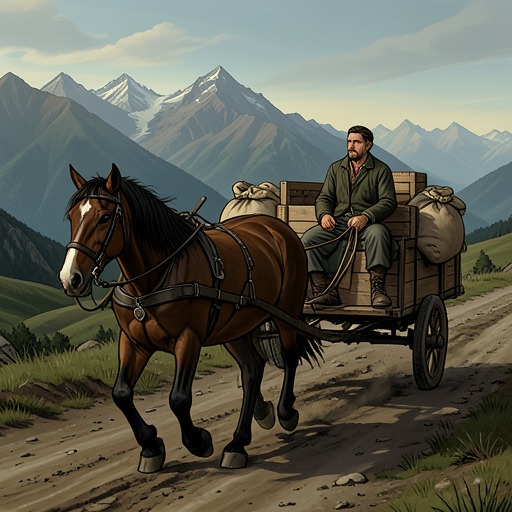
As Grainier later worked as a hauler along the Kootenai River and nearby roads, dogs became part of the region’s circulating folklore. People told astonishing stories of rescues, tricks, supercanine intelligence, and humanlike understanding. One prospector at Sylvanite survived after dynamite exploded in his shack because his dog made such a disturbance at the saloon that a patron followed it home and found its injured master. The dog’s insistence transformed an animal’s nuisance into an act of rescue, while the story reinforced the belief that dogs could understand danger and communicate human need.
Another episode turned that admiration toward fear. Grainier agreed to transport Peterson, a surveyor for Spokane International, after Peterson had been shot by his own dog. Peterson explained that the dog had slipped its rope and kept backing away whenever he approached. When Peterson swung his rifle to strike the animal with the barrel and butt, he was suddenly shot in the left shoulder and chest by his own gun. He treated the dog as an intentional adversary rather than as an animal caught in an accident, insisting that it “knew things.”
Peterson connected the dog’s altered behavior to the wolf-girl, a creature said to move with wolves. He reported that the dog had once escaped through a window, worked back and forth across the porch and yard, and then disappeared into the woods for thirteen days. After returning, it was nearly wild and barely recognized him. Kootenai Bob, according to Peterson, examined the dog closely and claimed to see the wolf-girl’s image in the black of its eyes, warning that the animal had been with wolves and should be shot before it brought the wolf-girl into the house. Peterson’s account is hearsay layered upon fear, but it demonstrates how a dog becomes the medium through which the community explains contact with an uncertain creature beyond the human boundary.
The dog stories also expose the instability of that boundary. A dog can rescue a prospector, outwit a tether, fire a rifle, or return from the forest “hardly” knowing its owner. Whether these actions are factual, misunderstood, or embellished in retelling, they make domestication appear provisional. The animal remains physically near human dwellings while retaining access to a knowledge imagined as wild, collective, and dangerous.
Disappearance, Replacement, and Ecological Change
By the hot summer of 1935, the red dog had been gone for years. She had grown old and sick and disappeared into the woods to die alone, and Grainier had never replaced her. Her absence intensified the loneliness he felt during the drought, when the heavy atmosphere and unbroken heat made him feel both physically weighted and emotionally empty. He traveled to Bonners Ferry partly in search of another dog, turning once again toward animal companionship as a practical answer to isolation.
The dog he eventually acquired was not another small red-haired wanderer but a large male of the far-north sledding type. This animal became his friend for many years. The replacement does not restore the earlier relationship: the first dog belonged to the fire’s aftermath and to the valley’s uncertain border with wolf life, whereas the sled dog belongs to Grainier’s later, more settled old age. The continuity lies in his need for a living companion; the difference lies in the changing form that companionship takes.
Dogs also register the valley’s ecological succession. In Grainier’s later years, the magnificent spruce had disappeared and been replaced mainly by scraggly jack pine; wolves were heard less often and from farther away, coyotes became numerous, rabbits scarcer, and trout vanished from long stretches of the Moyea River. The repeated movement between dog and wolf therefore carries environmental information. Dogs remain close to human settlement even as wolves retreat, making them a domesticated echo of a wilderness that is itself receding and changing.
Narrative and Thematic Significance
The dogs occupy several narrative roles at once. They are concrete animals with diets, illnesses, wandering habits, offspring, and deaths; they are also participants in a regional tradition of marvelous stories. The text does not settle whether the wolfish pup was truly part wolf, whether Peterson’s dog acted with deliberate intelligence, or whether the wolf-girl’s influence existed outside rumor and terror. That uncertainty preserves animal life as something not fully captured by human explanation.
At the same time, the dogs reveal the emotional economy of Grainier’s existence. The red dog interrupts his self-address, accompanies his rebuilding, and then disappears without granting him possession. The silent wolfish pup gives him a reason to howl. The later sled dog provides friendship after years without the first companion. In each case, the animal is not simply a symbol added to a human story: its wandering, silence, return, or absence changes what Grainier can do and how he inhabits the landscape.
The recurring canine presence also complicates the distinction between civilization and wilderness. Dogs are bought, transported, tethered, fed, displayed, and expected to obey, yet they repeatedly escape those categories. They cross into forests, associate with wolves, become subjects of tribal knowledge and frontier gossip, and sometimes appear more perceptive than their owners. Their stories ultimately make the human world look less self-contained. Grainier survives by living alongside animals, but the animals continually remind him that companionship does not mean mastery and that the wild can remain present inside, behind, or just beyond the domestic dog.